


Assembly/Disassembly Directors and Lift Directors perform distinct functions in construction crane operations. Both roles are defined under OSHA 29 CFR 1926 Subpart CC for cranes and derricks in construction. Confusing the two poses a compliance risk, as each role carries qualification requirements and operational authority that cannot be substituted for the other.
Supervisors, organizations, and crane professionals must understand the difference between an A/D Director and a Lift Director. This distinction maintains regulatory compliance and prevents authority conflicts during crane operations.
Assembly/Disassembly Director and Lift Director at a Glance
The A/D Director's authority is scoped to the assembly and disassembly phase of crane operations. They govern the assembly and disassembly of crane equipment under 29 CFR 1926.1404. The Lift Director's authority covers active lifting and load-handling operations.
Both roles are established under the regulatory framework for cranes and derricks in construction. Each addresses separate operational phases governed by distinct OSHA directives governing crane operations on construction sites.
What the A/D Director Does
The Assembly/Disassembly Director directs crane assembly and disassembly operations on construction sites. Under OSHA 1926.1401, an A/D Director is a worker who meets Subpart CC requirements for this role, irrespective of formal job title. The qualification standard under 1926.1404(a) requires the worker to meet criteria for both a qualified person and a competent person. They may also serve as a competent person assisted by at least one qualified person.
Core responsibilities under 1926.1404 include:
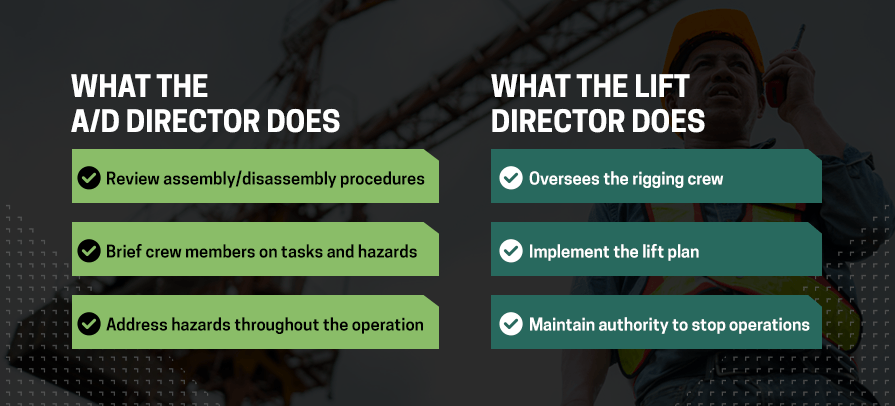
- Reviewing assembly/disassembly procedures: The A/D Director must review applicable procedures immediately before operations begin.
- Briefing crew members on tasks and hazards: All crew members must receive instruction on their specific tasks, associated hazards, and dangerous locations to avoid.
- Addressing hazards throughout the operation: The A/D Director maintains oversight and authority to address hazards as they arise during assembly and disassembly phases.
OSHA's Requirements for the A/D Director Role
Under 29 CFR 1926.1404, OSHA's assembly/disassembly requirements establish the qualification standard for the A/D Director role. The individual must meet the criteria for both a competent person and a qualified person, or a competent person must be assisted by a qualified person.
The A/D Director must understand applicable assembly and disassembly procedures and review them immediately before operations commence. They must brief the crew on tasks, associated hazards, and dangerous locations before operations begin. The A/D Director must be able to identify hazards in the work environment and possess the training necessary to direct crane assembly/disassembly safety operations.
Subpart CC includes OSHA's definition of the A/D Director, which establishes these requirements.
When an A/D Director Is Required
The A/D Director is required for all crane assembly and disassembly operations on a construction site. This includes:
- Initial crane setup: Establishing the crane for operational readiness.
- Climbing and jumping operations: Adjusting crane height and configuration.
- Boom assembly: Assembling boom sections and components.
- Dismantling: Disassembling crane equipment at project completion.
The A/D Director's authority is specific to the assembly and disassembly phase. This authority does not extend to active lifting operations.
What the Lift Director Does
The Lift Director directly oversees all load-handling activities and the associated rigging crew. Responsibilities include overseeing the rigging crew, implementing the lift plan, and maintaining authority to stop operations when unsafe conditions exist. The Lift Director supports compliance with OSHA definitions under Subpart CC and coordinates with mobile crane lift parties to maintain operational safety.
OSHA's Requirements for the Lift Director Role
OSHA requires the Lift Director to be either competent and qualified or to be a competent person assisted by at least one qualified person. Key requirements include:
- Hazard recognition: The Lift Director must recognize existing and predictable hazards in the work environment, including unsanitary, hazardous, or dangerous conditions.
- Authority to implement corrective measures: The Lift Director must possess the authority to take prompt corrective action when hazards are identified.
- Recognized credentials or knowledge: The worker must demonstrate a recognized degree, certificate, professional standing, or knowledge and training sufficient to resolve problems relating to crane lifting operations.
These requirements help the Lift Director maintain operational oversight and safety compliance throughout the lifting phase.
When a Lift Director Is Required
OSHA requires a Lift Director for active crane lifting and load-handling operations on a construction site. When an A/D Director is on-site supervising assembly or disassembly, a separate Lift Director is not required for that specific phase.
The A/D Director's authority governs during assembly and disassembly. The Lift Director's authority applies once lifting operations begin.
Can One Person Serve Both Roles?
The A/D Director and Lift Director roles are commonly confused. A person's ability to fill both roles depends on the phase of work and whether they meet the qualification requirements for each.
Key distinctions include:
- Assembly and disassembly operations: The A/D Director serves as the governing authority in this instance.
- Active lifting: The Lift Director will be responsible for active lifting on-site.
- Qualification requirements: A person qualified for both roles may be designated for each in turn, but the roles themselves are not interchangeable.
Industry standards, including ASME standards for mobile cranes, acknowledge that a worker can perform multiple assigned roles if they possess all credentials. The authority of the worker shifts precisely with the operational phase, and the roles remain separate in their responsibilities and periods of governance.
Which CCO Credential Applies to Each Role?
For the Assembly/Disassembly Director role, the corresponding credential is the NCCCO's A/D Director certification. The certification involves a 45-question written exam tailored to the Mobile and Tower crane specialties. The certification remains valid for five years and is administered by the National Commission for the Certification of Crane Operators.
For the Lift Director role, the corresponding credential is NCCCO's Lift Director certification. This certification requires candidates to pass an examination consisting of 45 questions, to be completed in 60 minutes. Specialty exams are available for Mobile Cranes and Tower Cranes, each consisting of 50 questions and a 90-minute time limit. Certification is valid for five years and is also administered by NCCCO.
Both credentials are nationally recognized and provide employers with a verifiable standard for designating qualified personnel. They provide a consistent, defensible benchmark for designating each role and align with applicable standards and regulations for crane operations recognized industry-wide.
Prepare Your Team With CCO® Lift Director Training
CICB's CCO® Lift Director preparatory training provides a structured pathway to prepare for the NCCCO Lift Director certification exam. Instruction is led by subject matter experts with industry credentials and crane operations experience. Since 1969, CICB has built training programs around the standards and regulations governing crane operations, delivering technical preparation aligned with OSHA and ASME requirements.
Lift Director preparatory training is available in Houston and Orlando. CICB also provides operational supervision services for organizations requiring on-site crane operation oversight. Contact CICB to prepare your personnel for the Lift Director designation.