
From connecting loads to guiding them into place, riggers make decisions that affect people, equipment, and schedules. Because the risks are high, the industry uses two terms to define who can handle these responsibilities — qualified and certified.
They may sound similar, but they mean very different things. The Occupational Safety and Health Administration (OSHA) requires qualified riggers in certain situations, while certification is voluntary and recognized across the industry. For safety managers, knowing the difference helps put the right people on the right tasks and avoid costly compliance mistakes.
Below, we explore the differences between qualified and certified riggers, breaking down OSHA’s definitions, training, and requirements so you will know which option is best for your operations and how each contributes to safer, more compliant lifting operations.
Understanding Rigger Qualification
The starting point in rigging safety is qualification. This is about whether an employer can demonstrate that a worker has the knowledge and experience to handle rigging tasks safely.
OSHA Definition and Requirements
In 29 Code of Federal Regulation (CFR) 1926.1401, OSHA defines a qualified rigger as someone with the training, recognized credentials, knowledge, or professional experience to solve rigging challenges in the workplace safely. Employers must evaluate their riggers against this definition.
Key aspects of qualification include:
- Employer responsibility: Employers decide who is qualified, and they must be able to show proof of how that decision was made.
- Task-specific evaluation: A worker may be qualified for one set of rigging duties but not another.
- Documentation: Employers must keep clear records showing how they evaluated a rigger and considered them qualified.
Scope of Work
Qualification comes into play whenever rigging tasks present risks to other workers. Per standards 1926.1404 and 1926.1425, OSHA specifically requires qualified riggers in situations such as:
- When rigging is used for assembly and disassembly.
- Hooking or guiding a load near workers who could be in the fall zone.
- Performing the initial connection of a load to a structure or other component.
Limitations of Qualification
Qualification has limits. For example, it does not carry over from one company to another and applies only to the tasks the employer assigns. This means that a rigger who changes employers will need to be reevaluated.
Understanding Rigger Certification
Certification is a different path. Instead of relying only on the employer’s evaluation, certification involves testing by an independent, accredited organization. This creates a credential that is recognized across the industry.
Certification Process
A widely known certification in the United States comes from the National Commission for the Certification of Crane Operators (NCCCO), which is accredited by the ANSI National Accredited Board (ANAB). Earning certification typically involves:
- Written examination: This covers rigging principles, safety regulations, and load calculations.
- Practical examination: Candidates need to demonstrate skills such as inspecting gear, choosing the right equipment, and connecting loads.
- Validity period: Certifications are valid for five years and must be renewed through testing and documented training.
Knowledge and Skill Requirements
Certified riggers are expected to have broader knowledge than those who are only qualified by their employers. The exams cover topics such as hazard recognition, load handling, and relevant OSHA and the American Society of Mechanical Engineers (ASME) standards. On the practical side, candidates must prove they can apply that knowledge under pressure.
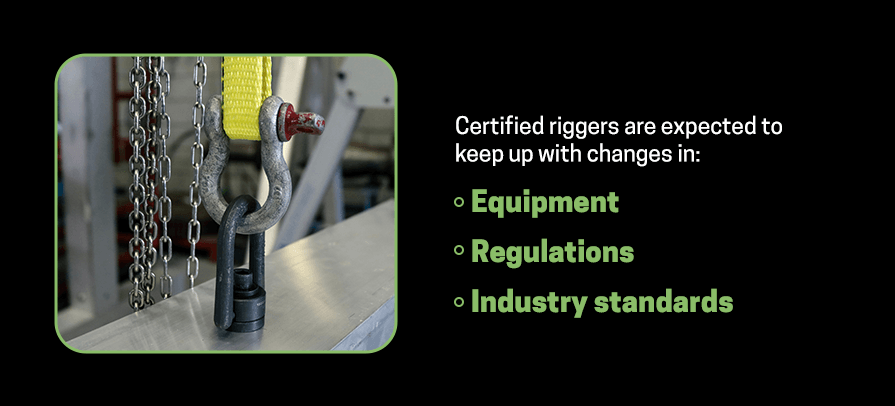
Certification also implies an ongoing commitment to professional growth through relevant rigging programs. Certified riggers are expected to keep up with changes in equipment, regulations, and industry standards.
Rigger Qualification vs. Certification: Key Differences
Qualification and certification are often confused. However, their differences are clear once you compare them side by side.
Verification and Documentation
OSHA does not require rigger certification, but qualification is, and certification is often required by employers or contractors.
- Qualified rigger: Verified by the employer, with internal documentation
- Certified rigger: Verified by an accredited third party, with a credential that can be used anywhere
Scope and Limitations
Qualification and certification also differs in how broadly they apply:
- Qualification: Narrow in scope, tied to the employer, and specific tasks
- Certification: Broader in scope, transferable across companies, and often recognized by clients and contractors
Industry Recognition
Each route has its place. However, industry acceptance varies:
- Qualification: Meets OSHA’s minimum requirements and works well for many day-to-day tasks
- Certification: Often required by contractors, project owners, or insurers for higher-risk operations
Practical Applications
Some jobs require a qualified rigger, while certification makes sense for others. It is important to understand when each is most relevant.
When to Use Qualified Riggers
Qualified riggers are sufficient for many everyday tasks where OSHA specifies the requirement.
Common examples include:
- Crane assembly and disassembly
- Routine hoisting activities
- Fall zone operations
- Standard lifts in lower-risk environments
When to Use Certified Riggers
Certified riggers are often required in situations where risks are higher or when outside parties demand extra verification of competence. This includes:
- Complex or unusual lifts
- Projects with strict contract requirements
- Specialized environments such as refineries or power plants
- Work where independent, third-party verification is necessary
Benefits and Career Impact
The difference between qualification and certification also directly affects workers. A few of the most common benefits include:
- Career advancement opportunities: Certification may qualify riggers for more complex projects.
- Employment mobility: Certification makes it easier to move between companies because the certification is transferable and not fixed to one company.
- Professional development: Both qualifications and certifications encourage continuous learning, which supports safer and more capable workplaces.
Frequently Asked Questions
Get your pressing questions on qualified and certified riggers answered.
1. What Is the Difference Between a Qualified and Certified Rigger?
A qualified rigger is evaluated by an employer based on OSHA’s definition of a qualified person, which includes training, knowledge, and experience. A certified rigger earns credentials through accredited third-party testing, such as NCCCO, which are transferable from one company to the next.
2. What Are the Options for Rigger Training?
Employers provide and document qualification training to meet OSHA regulations. Certification training, on the other hand, prepares riggers for accredited exams such as those offered by NCCCO.
3. What Are OSHA’s Requirements for Rigger Qualification?
OSHA requires qualified riggers in specific situations, such as during crane assembly and disassembly, when hoisting near workers, and when employees are in a fall zone. The employer must determine and document the qualification.
Choosing the Right Path for Rigging Safety
Rigger qualification and certification are often confused, but they serve different purposes. OSHA requires qualified riggers in specific workplace situations, leaving employers responsible for evaluation and documentation. Certification, on the other hand, comes from accredited third-party exams.
The best approach depends on your workforce and project requirements. Many companies use both qualifications for standard operations and certification for complex or high-risk lifts.
CICB is dedicated to supporting employers with training programs to prepare riggers for both qualification and certification needs. With experienced trainers and rigger training aligned to OSHA regulations and industry standards, CICB helps organizations build safer, more capable rigging teams. Contact us today to learn more about your options for training.